
What Genpact's agentic pivot tells you about your next outsourcing contract
A K&B Global point of view
On August 6, Genpact reported a quarter that is worth reading closely if you buy outsourced operations. Revenue came in at $1.34B, up 7.1% year over year and a slight beat. But adjusted EPS landed at $0.88 against a $0.97 consensus, and the stock slipped about 3% to $35. Q3 guidance was in line. The number management wanted you to hear was strategic, not financial: CEO BK Kalra said the "pivot to Agentic Operations is taking hold faster," and the company raised full-year Advanced Technology Solutions growth guidance to at least 25%.
Read those two lines together and the strategy is clear. Genpact is buying growth with margin. Revenue is solid, earnings missed, and the growth engine being sold to the market is agentic operations. This is not a criticism of Genpact. It is a rational move, and it is exactly what most of the large BPM providers are now doing. The question is what it means for the buyer sitting across the table.
The pitch you are about to hear
Over the next few quarters, your incumbent providers will walk into your quarterly business review with a version of the same slide: AI agents, embedded in your operations, doing more of the work. It is a genuinely powerful capability. It is also being sold to you on a commercial model that has not changed. You will still be quoted a price built on people, now with an AI premium layered on top. More capability, same unit of value: the seat.
Here is the problem with paying by the seat in an agentic world. When your provider automates a process and does the same work with a third of the people, who keeps the savings? Under a headcount-plus-markup contract, the provider does, by default, and you funded it. We have seen this pattern before with every prior efficiency wave. The savings are real, but they accrue to the party who controls the pricing model, not the party who owns the P&L. Agentic operations do not change that math. They accelerate it.
Green on the outside
There is a second, quieter risk. Agentic delivery is fast, and it reports well. Dashboards light up green, tickets close, cycle times drop. But we have a name for operations that report green while the business still bleeds cost: the watermelon effect. Green on the outside, red on the inside. Automate a broken process and you get a faster broken process, billed confidently, with a compelling AI narrative attached. The more sophisticated the automation, the harder it is for a buyer without an independent operating layer to tell whether the reported gains are real or whether they are simply better-looking activity.
The contract that actually protects you
The fix is not to slow down on AI. Agentic operations are coming and you should want them. The fix is to change what you are paying for. There are two models on the table, and the distinction is the whole game.
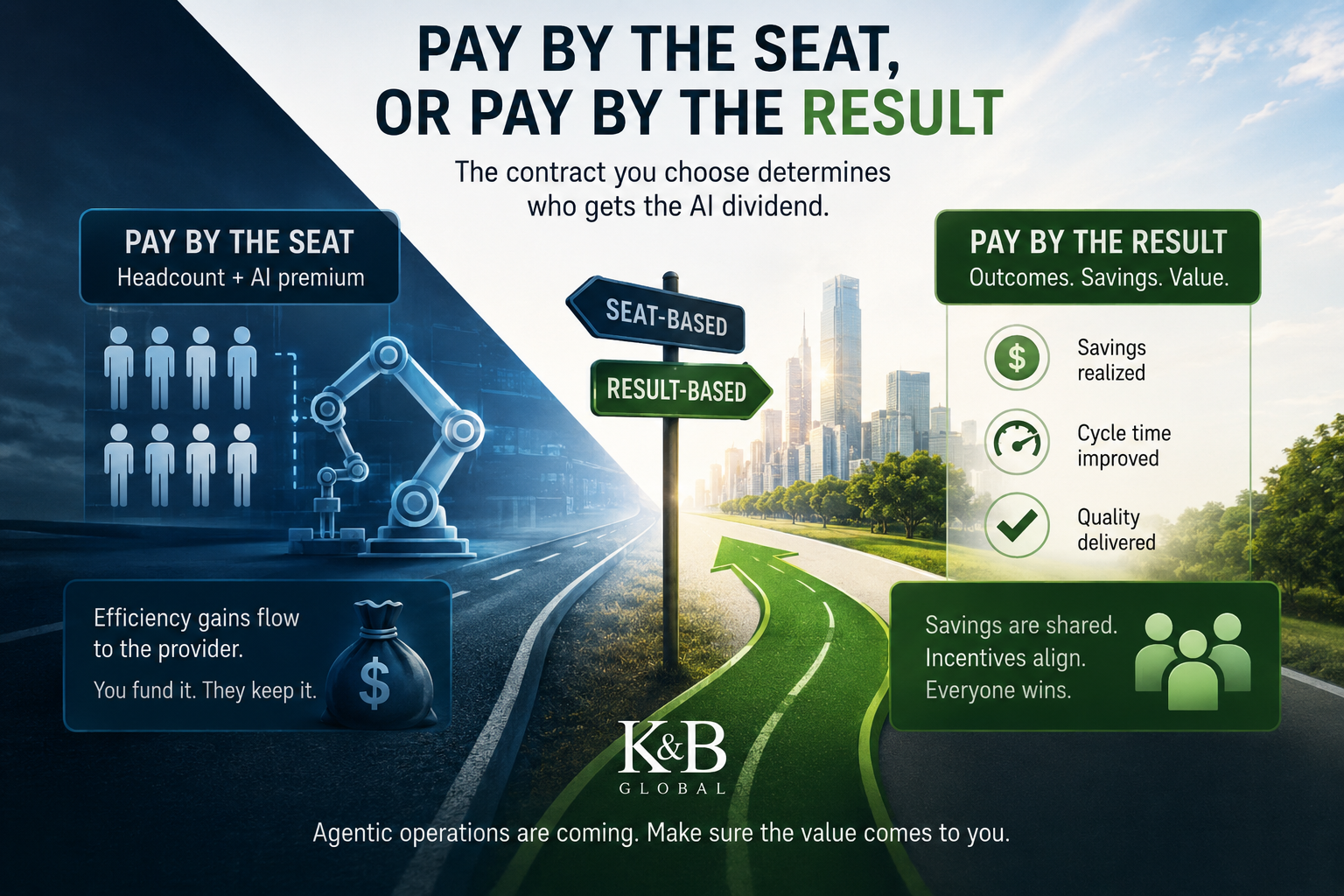
Agentic operations you pay for by the seat. You buy capacity plus an AI premium. The provider's incentive is to keep the unit count and the markup as high as the contract allows. Efficiency gains flow to their margin. This is the model Genpact's results are quietly built on, and it is the one most renewals will default to unless you intervene.
Operations you pay for by the result. Your fee is tied to the outcome the business actually realizes: the cost taken out, the cycle time delivered, the quality held. Under gain-share and outcome-based structures, when automation makes the work cheaper, the savings are split by agreement rather than captured by whoever owns the rate card. The provider still profits, and they profit more when you do. Incentives point the same direction for the first time.
The second model is harder to run, which is precisely why most buyers do not have it. It requires a baseline of real effort, a measurement layer that tracks outcomes as they land, and the discipline to convert them into contracted savings before the next renewal locks them into the vendor's margin. That operating layer is what we install, and it is the difference between a contract that captures the AI dividend and one that hands it away with a smile.
What to do before your next renewal
If you run a large outsourced operation, the agentic pitch is already in motion, and roughly $20B in IT and BPO contracts are up for renewal across the market in the next two years. Every one signed on the old seat-based logic locks the AI dividend into the provider's margin for the full term. Three moves protect you:
First, separate the capability from the commercial model. You can say yes to agentic delivery and no to seat-based pricing in the same conversation. They are not a package.
Second, insist on a measurable outcome as the unit of value, and build the mechanism to prove it. A gain-share clause you cannot measure is theater.
Third, put an operating layer between you and the reported numbers before the automation scales, not after. Once a green dashboard is the system of record, you have lost the baseline you needed to negotiate.
We have restored command and control on 300+ outsourcing contracts and protected more than $2B in client value by staying through execution, not exiting at signature. The providers are repricing their growth around AI right now. This is the moment to reprice your contracts around results, while you still hold the leverage to do it.
If your next major renewal is inside 18 months, that is the window. We will map one vendor contract against our cross-client benchmarks and show you exactly where a seat-based model is about to hand your AI savings to the provider, and what a result-based structure recovers. The review can be structured under our vendor-funded delivery credit model, validated at Toyota and BP, so it does not have to carry net new cost.
Sources:
- StockStory / FinancialContent, "Genpact's (NYSE:G) Q2 CY2026 Sales Beat Estimates," August 6, 2026 - https://markets.financialcontent.com/stocks/article/stockstory-2026-8-6-genpacts-nyseg-q2-cy2026-sales-beat-estimates
- Genpact Investor Relations, "Genpact to Report Second Quarter 2026 Results" - https://media.genpact.com/2026-07-08-Genpact-to-Report-Second-Quarter-2026-Results